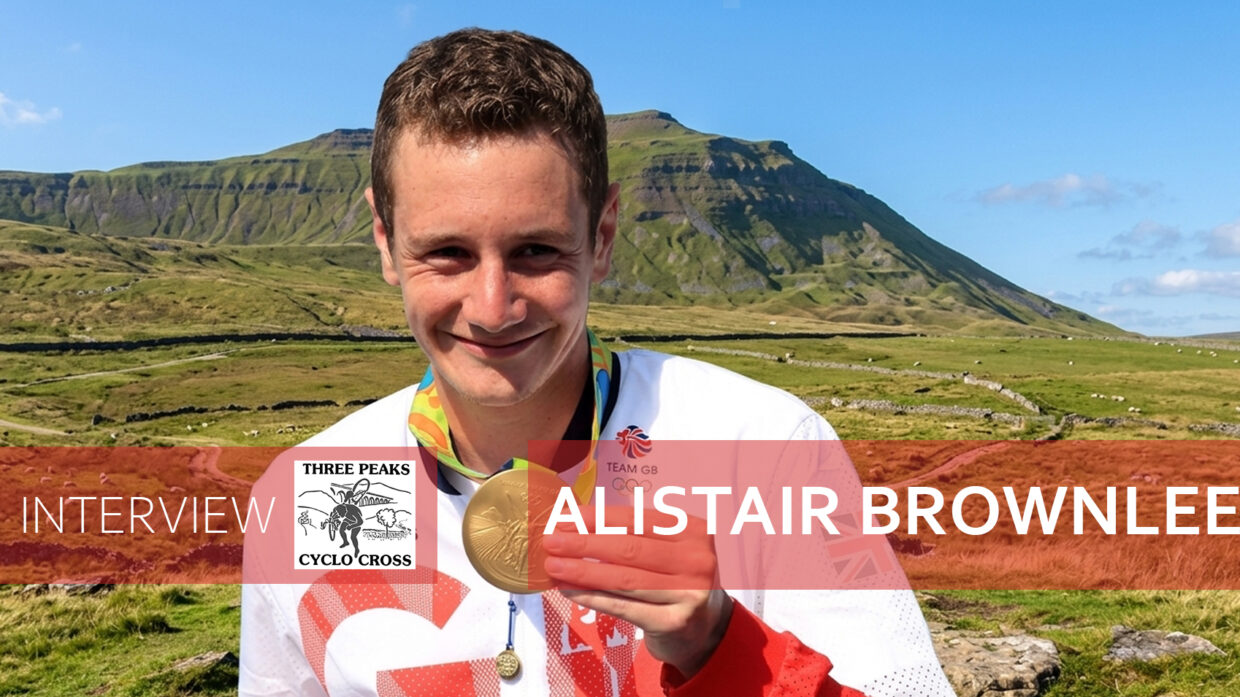
What do you ask a sporting hero who is as synonymous with Yorkshire sport as Geoffrey Boycott? Find out as 3 Peaks debutant Alistair Brownlee talks with me about the race, his journey to finally getting to it, and his deep experience of fell and mountain sport that the average Joe on the street would not expect from a two-time Olympic gold medal triathlete.
A joy to catch up with one of the race’s most exciting first-timers. Enjoy….!
Double Olympic triathlon champion Alistair Brownlee has taken on some of the world’s toughest endurance challenges, but one iconic race has eluded him since childhood—until now. This September, the Yorkshire native and Bingley Harrier will take to the start line at Helwith Bridge for the World Three Peaks Cyclocross Championships.
In a wide-ranging interview, Alistair sat down to discuss his transition from elite triathlon, his approach to training without structure, reflections on his Three Peaks Fell Race debut, and the practicalities of setting up a bike for one of the most grueling off-road races in Britain.
A Childhood Dream and Yorkshire Roots
Dave Haygarth: Alistair, the Three Peaks Cyclocross is an institution, but how long has this race been on your radar?
Alistair Brownlee: Since I was about ten years old, really. I remember watching it as a teenager and cycling up to spectate on the hills multiple times when I was growing up. Being a Bingley Harrier, fell running and cyclocross were a huge part of my childhood. That environment, the exploration, and the community—that’s what underpinned my entire career in endurance sport. Doing the Three Peaks Cyclocross has sat near the very top of my post-professional bucket list for years, but during my triathlon career, the timing never aligned. Now, it’s finally happening.
Dave: You’ve always credited that outdoor freedom over rigid training regimes for building your base.
Alistair: Exactly. The volume of broad, enjoyable outdoor activity—not rigid, structured sessions—is what built my endurance base. The fundamentals of performing in an endurance event, whatever it is, is simply doing a lot of it.
Life After Professional Sport: Freedom and Ultra-Distance
Dave: Since retiring from professional triathlon, your race calendar looks completely different. What have you been up to?
Alistair: I wanted to pursue a deliberate variety of events that I never had time for during my professional career. I did the Three Peaks Fell Race last year, completed Badlands down in the south of Spain, and tackled the Dales Divide over Easter—600 kilometers in about 36 hours. I’ve even done some ski mountaineering.
With ultra-distance racing, you get into a zone. It’s very methodical, and you’re in your own world.
Dave: How has your day-to-day training changed?
Alistair: I haven’t done a single formal training session in over two years—no structured intervals or repetitions whatsoever. I go out and run or ride when I feel like it, smash it up a hill if I’m in the mood, or jump into local group rides. It’s entirely unstructured.
Looking Back: The Three Peaks Fell Race Podium
Dave: Last year you made your debut at the Three Peaks Fell Race and finished on the podium—an incredible result for a first attempt. How did that race unfold for you?
Alistair: My strategy went largely as I expected. I led out of Pen-y-Ghent, but lost ground on the descent. I regained the lead at Ribblehead and was first to the top of Whernside, but lost positions again descending.
Climbing is my natural strength, so the uphills felt manageable. The downhills were where I suffered due to a lack of recent technical downhill running—the eccentric loading on the legs takes a massive toll if you haven’t trained for it specifically. And like everyone who does the race, the descent from Ingleborough felt remarkably long!
Dave: How did you find the mental side compared to elite Olympic competition?
Alistair: Completely relaxed. I had no anxiety about performance or external expectations. I was competing purely for personal enjoyment.
What to Expect at the Three Peaks Cyclocross
Dave: What are you most looking forward to at the Cyclocross event in September?
Alistair: The atmosphere and the contrast of the terrain. You can be in total solitude in a remote section like Simon Fell, feeling like you’re in a no man’s land, and suddenly you round a corner on the hillside and hit massive, roaring crowds. I know the terrain well from walking and running, but I’m definitely planning a dedicated recce ride on the cyclocross bike beforehand.
Dave: Any chance we might see your brother Johnny on the start line in the future?
Alistair: Johnny is just at the stage where he’s starting to think about these kinds of events. I definitely believe he’ll give it a go at some point.
The Tech Talk: Bike Setup and Gear Advice
Navigating the Three Peaks Cyclocross requires a specific equipment strategy to handle the mix of road, bog, limestone, and steep carries.
Dave: Setup is critical for this race. Here is what we recommend for tackling the terrain safely and efficiently:
- Tyres: Run a lightly treaded 38mm tyre. Avoid full gravel slicks due to braking grip requirements, but stay away from heavy mud lugs as grass traction isn’t the main issue. The newer Panaracer Gravel Kings offer excellent sidewall protection.
- Tyre Liners & Pressure: Insert liners such as Cushcore or Vittoria. While they aren’t fun to ride flat, they keep you moving if you lose pressure. Run around 30 PSI (tubeless with liners) for a rider of Alistair’s weight to prevent pinch flats and unsealing blowouts on sharp rocks.
- Gearing: Go as low as possible. As race legend Nick Craig emphasizes, your legs will be exhausted by the time you reach Pen-y-Ghent after carrying the bike up Whernside and Ingleborough. A setup with a 38T front chainring and a 50T rear cassette (or double chainset setup like Lachlan Morton and Giles Drake) ensures you can ride Pen-y-Ghent if you have anything left in the tank.
- Preparation: Bed in your tyres over 2–3 off-road rides before race day, and ensure any spare wheelsets brought by support are fully compatible (axle, cassette, disc spacing).

